Heather LaRoi
Wisconsin State Journal
UW-Madison engineering student Zach Heise, a member of the Campus Antiwar Network that organized the recent protest of Halliburton 's appearance at a campus recruiting fair, said he knew the rally was being videotaped by campus police.
He even talked to the plainclothes officer with the camera. "I saw his earpiece. I asked him and he told me right away he was with the police, " Heise said. "I personally have no problem with the police videotaping us. If that 's part of their standard procedure ... I 'm not going to make a big deal of it. "
The times, they are a-changin '. While even the suggestion of activities being recorded without permission might have given another generation hives, many of today 's students live with -- and accept -- the knowledge that much of what they do in public might be on video somewhere. In stores, in bars, on street corners, reality TV or YouTube, privacy is often a sketchy notion.
"People my age are used to seeing videos of themselves everywhere, not necessarily with their permission, " Heise said. "If they distribute this video of me being an antiwar protester, then it will merely join the dozens of publicly available videos that show me doing what I do. "
To others, the idea that people are being videotaped raises concerns.
UW-Madison history professor James Donnelly, who asked questions about the taping of the Halliburton rally during a faculty senate meeting this week, has called for a university committee to look into such practices.
"Everyone needs to be properly concerned about public safety, but there should also be some concern with whether or not the police presence and the nature of the police presence at political demonstrations is of a character not to interfere with constitutionally guaranteed rights of freedom of speech and public assembly, " Donnelly said.
Further, Donnelly said, a written policy regarding the circumstances that call for police use of video ought to be reviewed and reviewable by the university.
"The potential for abuse is there. It 's not a wild-eyed idea, " said Chris Ahmuty, executive director of the American Civil Liberties Union (ACLU) of Wisconsin.
UW police defend videos
Ahmuty, based in Milwaukee, said while the legally protected expectation of privacy is weakened when a demonstration takes place in a public place, other concerns arise. Chief among those is why a videotape is made.
UW-Madison Assistant Police Chief Dale Burke said taping such gatherings is normal operating procedure these days and has been the department 's practice for about as long as the technology has been available.
Police typically tape gatherings where there 's concerns about crowd control or where it is deemed there is a potential for criminal behavior, he said.
"It 's an attempt to document what 's taking place, " Burke said.
Tapes are made both to protect police from allegations of misbehavior as well as to provide documentary evidence if a crime is committed, he said.
At Camp Randall, for instance, there is a camera in the press box as well as several others around the stadium that are remotely controlled by UW-Madison police to scan for trouble spots or track any incidents that come up, with a similar arrangement at the Kohl Center.
City police also use videos
The UW-Madison Police Department isn 't the only law enforcement agency using video cameras.
The Madison Police Department regularly relies on cameras and videotape surveillance to assist in law enforcement. At the upcoming Halloween festivities on State Street, for example, you can pretty much count on being taped, said Madison police spokesman Joel DeSpain.
"The cameras on State Street are mostly to identify where there might be potential problems building up on the street or to capture actual crimes that are taking place, " DeSpain said. "It also enables the people who are in the command post to see what 's going on and to get officers on the ground to locations quickly. "
Surveillance tapes also figure large in crime investigations.
"Just about every crime now, we 're going to seize and look at surveillance tapes, " DeSpain said.
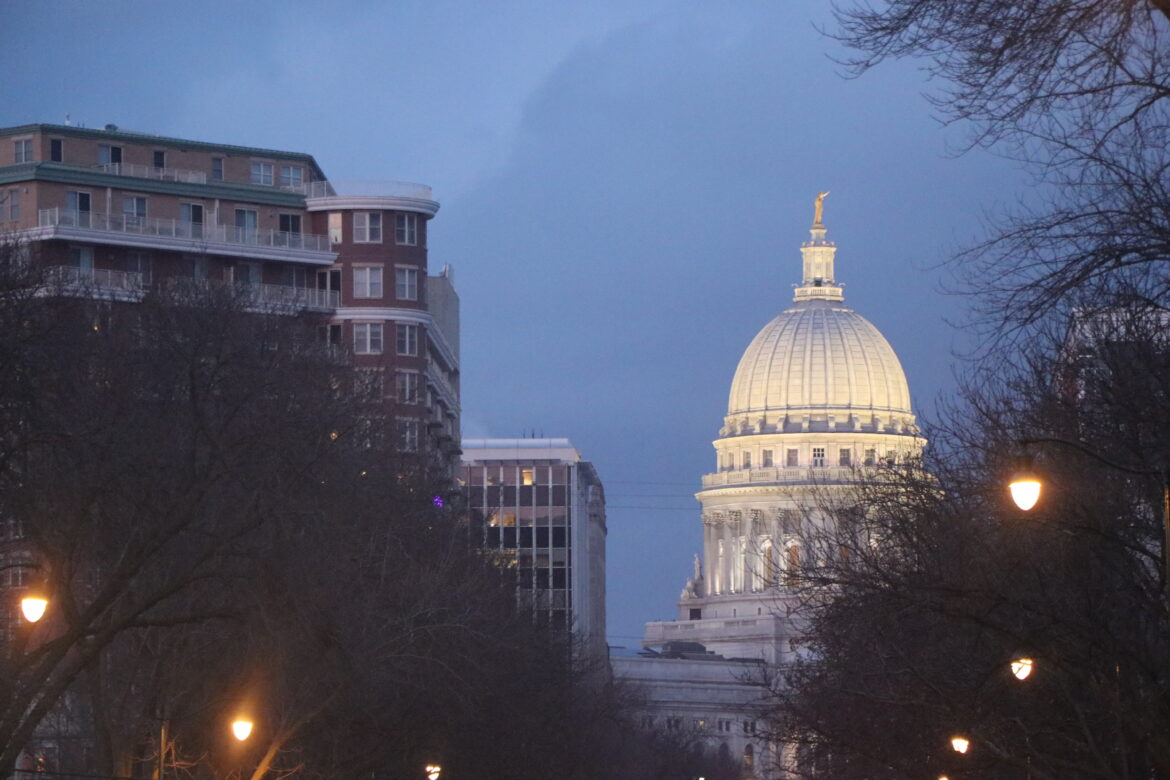
Capitol Police also employ surveillance cameras 24-7 in and around the Capitol.
Some tapes are destroyed
Some wonder what happens to a tape after an event. If the reason for making the tape was to document any wrongdoing and none occurs, is the tape destroyed?
Burke said UW-Madison Police keep all tapes for 120 days, which is the length of time allowed for any complaint to be lodged. After that time, the tape is erased and re-used, he said. It 's the same policy used for videotapes in squad cars, he added.
According to Capitol Police Sgt. Dan Blackdeer, the digital recordings of the Capitol area are kept for about 21 days.
Still, Ahmuty of the ACLU points out that under the Homeland Security Act, there are a lot of gray areas when it comes to defining what constitutes the kind of behavior or expression of views that merits watching these days.
"You may fear the fact that they might create a dossier on you, " Ahmuty said. "Are they taking group shots or were they zeroing in on people who appeared to be leaders or people addressing the crowd?
"They 've got to have some basis for how they 're going to conduct the videotaping that 's connected somehow to a legitimate law enforcement purpose. "
Burke said police officials are aware of such concerns.
"If you remember back to the '60s, I can understand where those fears come from, " Burke said. "All I can say is this is what we do and why. "
Not intimidated
For Donnelly, it 's reassuring that students such as Heise aren 't intimidated by the police presence while expressing their views, "because that is the concern here. "
Heise said his parents have warned him he could be blacklisted for his protest involvement.
For his part, he's unconcerned.
"Since we were all at the protest of our own free will, I doubt too many of us would be offended to see videos of ourselves protesting, " he said.
This story originally appeared in October 3, 2007, editions of the Wisconsin State Journal.
Recent comments
42 weeks 3 days ago
44 weeks 3 days ago
1 year 2 weeks ago
1 year 2 weeks ago
1 year 3 weeks ago
1 year 3 weeks ago
1 year 10 weeks ago
1 year 45 weeks ago
1 year 46 weeks ago
1 year 46 weeks ago